Restroom Trailer Rental in Pinellas County, FL
Porta potty rental typically runs $150–$300 nationally, per our cost guide. Independent local pros serving St. Petersburg, Clearwater, Largo and nearby communities. Describe the problem and we'll route your request — free, no obligation.
- Sizing from real planning math — one stall per 50 guests is the starting point
- Share your venue, load-in, or site schedule up front
- Power, water, and level-ground questions to settle before the quote
- Free to use — providers set their own pricing, you compare in writing
Fast response from independent local providers. No obligation.
Typical national cost$150 – $300Cost guide →Local Help in Pinellas County, FL
For county property, Pinellas County's Special Events & Facilities Use Guide, dated 1/2024 (rev. 1-24) and still linked through the county's special events page, says portable restrooms and hand-washing stations “are required for special events in open venues without public restroom facilities, or in the event the expected attendance is greater than current recommended capacity for established restrooms.” Its tables size restrooms by attendance and hours, and hand-washing stations by attendance, each with and without alcohol. For 1,000 people over eight hours they give 8 restrooms without alcohol or 9 with it, and 6 or 8 hand-washing stations.
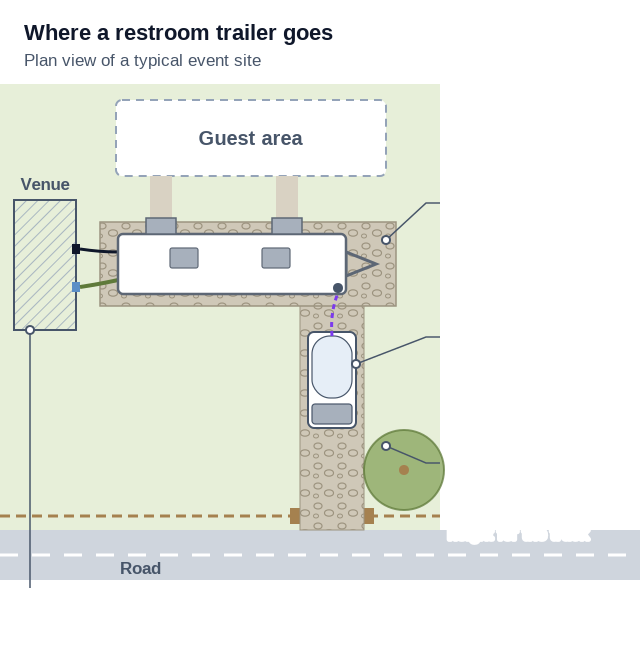
The guide adds that “at least one unisex portable restroom and hand-washing station will be required for the disabled” and refers organizers to their local ADA office. Locations should be well marked, cleaned and maintained throughout the event, adjacent to hand-washing stations, adequately lit if nighttime use is anticipated, serviced (including pump-out), distanced away from food and beverage storage and service areas, and secured to prevent tipping. The applicant orders and pays for the units and oversees delivery, setup and removal.
Pinellas County Service Details
What providers in this area actually see: coverage, common jobs, local pricing factors, and rules worth knowing.
Service Area Notes
- Which office: the county's guide page says the guide covers unincorporated Pinellas County and/or events held on county-owned property, and the PDF says it does not include processes for cities or townships within the county. Parks & Conservation Resources handles park uses and events, including road closures inside parks.
- Cities: the county's municipalities page says “Pinellas County has 24 incorporated municipalities” and that unincorporated “refers to all property that is not within city limits.” Every city in this page's Communities Served list is a 2020 Census incorporated place in Pinellas County; on city land, that city's own event rules apply.
Common Jobs in Pinellas County
- Festivals, races and company picnics in county parks sized from the county chart
- Beach events at Fort De Soto Park or Sand Key, which has its own application
- Clearwater events whose site plans show portable restrooms
- Construction sites counted with Table PR II and OSHA Table D-1
What Drives Pricing Here
- One vendor's list prices, not a local rate: Stahla Services' cost guide (dated January 8, 2026; its table says updated 10.15.2026) lists per-event prices, an event running from Friday delivery to Monday pickup, of $2,799 (2 Stall Restroom Trailer) and $3,399 (4 Stall). A note under the table says “Prices are base rates valid for 30 days and do not include additional fees,” listing mobilization ($3.99/loaded mile) plus per-trailer setup and pack-up charges, each higher for ADA trailers.
- Alcohol: in the county tables, 500 people for four hours need 4 restrooms without alcohol and 5 with it. Alcohol on county property is prohibited unless the County Administrator approves an alcohol waiver or county contract review staff, including the County Administrator, approve a contract.
- Time on site: units must be “delivered 24 hours or the previous business day before the event and removed from county premises 24 hours after the event or the next business day.” Ask if quotes cover those days.
- Insurance: the guide holds vendors the applicant hires for commercial services at an approved event to the applicant's minimum General Liability requirements and requires proof of Commercial Auto Liability coverage if a commercial vehicle is used, including delivery of goods or services on county property. Proof for the applicant and all vendors, hired or donated, “must be submitted no later than 30 days before the event.”
- Power: the county does not guarantee electricity at its facilities, parks and preserves; a privately-owned generator needs permission requested with the application and may not sit in an enclosed area or adjacent to a residential area.
- Fees: the county and Clearwater pages print event fees with no effective date; ask each office.
Permits & Local Rules
- County lead time: the special events page says applications “must be submitted a minimum of 90 days before the event, and no more than one year in advance,” while the guide says “90 business days prior to the event, but no earlier than one year in advance” and notes that departments other than Parks & Conservation Resources may not review an application until 90 days out. Confirm the deadline with the county's special events coordinator.
- County triggers: the guide requires an application if attendance will be 100 or more, alcohol is requested, vendors sell goods or services, amplified sound goes beyond a small personal speaker, the event closes or changes the traffic pattern, it affects public use of a park or natural resource, it uses temporary structures (tents larger than 10x10, bleachers, a blow up start/finish line, stages), or it is for an organization or company.
- County restroom paperwork: proof of purchase goes to the county's special event contact for the department receiving the application “no later than 30 calendar days prior to the event,” the checklist lists contacting and documenting payment for portable restrooms, if applicable, at 60 days, and a Special Event application's site map must show the location and dimensions of portable toilets and other equipment.
- Clearwater: the Special Events Division requires an application only for events meeting one or more of these: 150 people or more, amplified sound, use of or impact upon public property, facilities, parks, sidewalks or streets within city limits, income from attendees, or alcohol served or sold. Its site plan, which may not be hand-drawn, must show portable restrooms. The page accepts applications no more than 365 and not less than 30 days ahead, based on the event's classification, yet its fee table lists an expedited category for applications under 30 days out that needs additional review; ask the division. A beach ceremony needs its own permit when it has income from attendees, over 25 people, a small arch, chairs or a 10 x 10 tent, or amplified sound (portable speakers or a P.A. system; no D.J.), and the city does not permit beach activity north of Avalon Street.
- St. Petersburg: Parks & Recreation defines a cosponsored event as one “held by or for the benefit of a local nonprofit group” on city parkland that also has an admission charge, selling or vending, donations solicited or accepted, or alcohol served or sold. Ask it about restrooms.
- Dunedin: the city's event permit page still points organizers to its Event Policies & Procedures Manual, marked rev 9-2014. It says the promoter “may be required to provide portable restrooms depending on scope and size of the event” and that “in general, one portable toilet will be required for every 250 people in attendance,” plus one ADA toilet for every 10 toilets in each location and daily cleaning at multi-day events; units may go in one day before and must be removed after the event. Confirm these 2014 terms with Dunedin Parks & Recreation.
- Organizer's contract: under Rule 62-6.0101(7)(d) of the Florida Administrative Code (effective 6/21/2022), a signed contract or fax copy with the portable restroom service company goes from the special event organizers to the Department at least one working day ahead, listing the units' on-site dates, their number, how often they will be serviced and the removal date. The Department is DEP, which its Onsite Sewage Program page says has implemented Florida's onsite sewage statutes and rules since July 1, 2021; ask DEP or the Florida Department of Health in Pinellas County where the contract goes.
- Servicing and hauling: in section 381.0065(3)(m), the 2026 Florida Statutes direct DEP to “permit and inspect portable or temporary toilet services and holding tanks,” and Rule 62-6.0101(1) sets the annual DEP service permit. Someone who owns portable restrooms without being a permitted service company needs a service contract with a permitted company covering each unit in use, and each unit must show the owner's name and telephone number. Wastes go to a Department-approved treatment facility, and a company using quaternary ammonium sanitizing and deodorizing compounds may not have them treated or disposed of at lime stabilization facilities.
- Food booths: the county guide points food service to DBPR. “No less than three business days prior to the scheduled event,” its guide says, sponsors should notify the Division of Hotels and Restaurants of what food service is proposed, when and where the event is, every participating vendor owner and operator, and each participating establishment's current license number, sent by email with the sponsor's contact information. Under Rule 61C-4.010(8)(a), food vendors participating in temporary food service events “shall not be required to provide public bathroom facilities”; Rule 62-6.0101(7)(m) bases food handlers' restrooms and hand washing at special events on that rule or applicable local or state food hygiene requirements, whichever is greater.
Season & Site Notes
- Fixed restrooms: county park rules say “some neighborhood and beach access parks do not have restroom facilities.” The guide does not permit vendors to drive vehicles in the event zone “during the hours the event is open for public access”; ask the county how that applies to restroom servicing.
- Climate: in NCEI's 1991–2020 monthly normals for station USW00012873, St Petersburg Intl AP, July precipitation is 9.73 inches, the August normal high is 90.6°F and November precipitation is 1.64 inches.
- NHC gives June 1 to November 30 as the official Atlantic hurricane season and says most activity occurs between mid-August and mid-October.
- October 2024: before Hurricane Milton, the Sheriff's Office posted an order limiting barrier island access to “only residents, business owners, and employees” from 7:00 p.m. on October 7 and closing “all access to the barrier islands” from 7:00 p.m. on October 8.
Communities Served
St. Petersburg · Clearwater · Largo · Pinellas Park · Dunedin · Tarpon Springs · Safety Harbor · Oldsmar · Seminole · Gulfport · St. Pete Beach · Treasure Island · Madeira Beach · Indian Rocks Beach
Emergency Response Expectations
A near-term county booking still faces the application lead time, which the county's special events page gives as a minimum of 90 days and its guide as 90 business days, and the 30-calendar-day proof-of-purchase deadline; ask the special events coordinator to confirm the deadline first. The guide says the county may cancel or postpone events due to any type of natural disaster, so get retrieval and rescheduling terms in writing.
Pinellas County FAQs
How does the county chart relate to Florida's Table PR I?
Table PR I in Rule 62-6.0101(7)(d) is for service company operators sizing special events “in situations where no local or state codes provide a minimum number of toilet facilities,” and the rule lets the portable count be reduced based on the number of attendees available permanent restrooms are designed to accommodate. The county guide tells applicants to use its own tables on county property; ask Parks & Conservation Resources which count it will accept.
How often must event toilets in Pinellas be serviced?
Rule 62-6.0101(7)(j) requires daily servicing, at minimum, for portable restrooms at special events. Table PR I's counts are built on one service per day; servicing twice a day divides the table figure by two, three or more pumpings a day divide it by three, and any fraction rounds up to the next whole restroom.
When does a Pinellas event need hand wash stations?
County property: restroom locations should be adjacent to hand-washing stations. Where food is served or picnic areas are provided at special events and remote locations, Rule 62-6.0101(7)(l) wants one portable hand wash facility for every ten portable restrooms required; hand sanitizer may replace them at the applicant's option, other than where food is served. DBPR's inspection basics for food vendors include a hand washing facility (it says this can be a food-grade container equipped with an on/off valve) using water from an approved source, plus soap and paper towels.
Can a wedding or event use the Fred Howard Park beach?
No. Effective April 1, 2026, the county will not consider wedding ceremonies and events for the beach section of Fred Howard Park due to occupancy and parking constraints. It suggests Fort De Soto Park or Sand Key Beach, which has its own event and wedding application.
How many toilets does a Pinellas building site need?
Under Rule 62-6.0101(7)(a), commercial and residential building sites must have restroom facilities whenever workers are present, for as long as construction lasts, and the facilities must stay accessible whenever the intended users are present. Table PR II assumes people on site 8 hours per day and 40 hours per week and service once a week: 1–10 people, 1 restroom; 11–20, 2; 21–30, 3; 31–40, 4; 41–50, 5; over 50, add 1 restroom for every 10 additional people or fraction thereof. Servicing twice a week divides the figure by two and pumping three or more times a week by three, rounding up. Several building sites of one contractor are treated as a single site for counting facilities, and shared restrooms must be within 300 feet of every site they serve. OSHA's Table D-1 at 29 CFR 1926.51(c): 20 or less employees, 1; 20 or more, 1 toilet seat and 1 urinal per 40 workers; 200 or more, 1 toilet seat and 1 urinal per 50 workers. Under (c)(4), paragraph (c) does not reach mobile crews having transportation readily available to nearby toilet facilities.
Which accessibility terms cover portable units at a Pinellas event?
On county property, at least one unisex portable restroom and hand-washing station for the disabled. Exception 3 in section 213.2 of the 2010 ADA Standards provides that where multiple single user portable toilet or bathing units are clustered at a single location, no more than 5 percent of the toilet and bathing units in each cluster have to comply with 603, and complying units carry the International Symbol of Accessibility. It speaks only to clustered single-user portable units; a multi-stall restroom trailer is not one. Section 203.2 says portable toilet units provided for use exclusively by construction personnel on a construction site “shall not be required to comply with 213 or to be on an accessible route.”
Sources
- Pinellas County: Special Events/Weddings
- Pinellas County: Special Events Guide (PDF, rev. 1-24)
- Pinellas County: guide web page
- Pinellas County: Park Rules
- Pinellas County: Municipalities and Cities
- Clearwater: Apply for a Special Event Permit
- Clearwater: Get a Beach Ceremony Permit
- St. Petersburg Parks & Recreation: Cosponsored Events
- Dunedin: Apply for an Event Permit
- Dunedin: Event Policy & Procedure Manual (rev 9-2014)
- Fla. Admin. Code R. 62-6.0101 (effective 6/21/2022)
- Florida DEP: Onsite Sewage Program
- Florida DOH-Pinellas: Onsite Sewage
- 2026 Florida Statutes, section 381.0065
- Fla. Admin. Code R. 61C-4.010 (effective 10/18/2023)
- Florida DBPR: Guide to Temporary Food Service Events
- eCFR: 29 CFR 1926.51
- ADA.gov: 2010 ADA Standards
- NOAA NCEI: 1991–2020 normals, USW00012873
- NOAA NHC: Tropical Cyclone Climatology
- Pinellas County Sheriff: Milton evacuation order (Oct. 2024)
- U.S. Census Bureau: 2020 FL place-by-county file
- Stahla: 2026 restroom trailer cost guide (Jan. 8, 2026) (third-party estimate)
Last reviewed 2026-11-05
Services Available in Pinellas County
Restroom Trailer Rental
Multi-stall restroom trailers with running water, climate control, and interior finishes — quoted by local rental providers.
Learn more →Luxury Restroom Trailer Rental
Premium trailers for weddings and upscale events — wood-look interiors, AC/heat, and attendant options from local providers.
Learn more →Wedding Restroom Trailers
Elegant restroom trailers sized for your guest list — barn, vineyard, and estate weddings deserve better than a porta-potty row.
Learn more →Event Restroom Trailers
Restroom trailers for festivals, corporate events, and public gatherings — sized to attendance and quoted by local providers.
Learn more →Construction & Long-Term Rentals
Job-site restroom trailers and porta-potties with scheduled service — OSHA-ratio sizing and monthly rates from local providers.
Learn more →Porta Potty Rental
Standard and ADA portable toilets for job sites and events, with scheduled service — quotes from local sanitation providers.
Learn more →Free Tools Before You Call
Ballpark the cost or narrow down the problem before talking to a Pinellas County provider.
Restroom Trailer or Porta Potties? 60-Second Decision Quiz
Trailer or porta potties? Answer a few quick questions about your event and get an honest verdict — plus the exact tool to size and price it.
Use the free tool →Restroom Trailer Size Calculator
Find out how many stalls — and which trailer size — your guest count actually needs, with alcohol and event length factored in.
Use the free tool →Restroom Trailer Rental Cost Estimator
Get a realistic 2026 price range for renting a restroom trailer — by size, rental length, season, and extras.
Use the free tool →Need help in Pinellas County, FL?
Send the short form — urgent requests get priority routing.