Restroom Trailer Rental in Atlanta, GA
Porta potty rental typically runs $150–$300 nationally, per our cost guide. Independent local pros serving Downtown, Midtown, Old Fourth Ward and nearby areas. Describe the problem and we'll route your request — free, no obligation.
- Sizing from real planning math — one stall per 50 guests is the starting point
- Share your venue, load-in, or site schedule up front
- Power, water, and level-ground questions to settle before the quote
- Free to use — providers set their own pricing, you compare in writing
Fast response from independent local providers. No obligation.
Typical national cost$150 – $300Cost guide →Local Help in Atlanta, GA
Atlanta Code of Ordinances section 142-24(a) says all outdoor events that provide portable restrooms must have a portable restroom sub-permit. Section 142-39(a) adds events that Fulton County or DeKalb County requires to provide them, and events for which Fulton County's health standards for for-profit organizations would require them if the applicant were a for-profit organization located in Fulton County. The sub-permit carries no fee under 142-39(b).
The Mayor's Office of Special Events (MOSE) takes the application and forwards it to the fire rescue department, which under 142-39(f) is the sole decision-maker on issuing it and applies, at a minimum, the health standards Fulton County requires for for-profit organizations, whether the applicant is a non-profit or a for-profit. It may require more units than Fulton County would where public health mandates the greater quantity. The office of parks, for units in a park, or the department of transportation, for city right-of-way outside a park, sets the exact location and delivery and removal times.
Atlanta city sits in two counties, DeKalb and Fulton, according to the Census Bureau's 2020 Georgia place file, and the sub-permit needs a certificate from whichever county the event is in, showing it approved the use and quantity of portable restrooms.
Atlanta Service Details
What providers in this area actually see: coverage, common jobs, local pricing factors, and rules worth knowing.
Service Area Notes
- MOSE does not permit events at Chastain Amphitheater, Chastain Horse Park, Atlanta Botanical Garden, Zoo Atlanta, the Piedmont Park Multi-Purpose Complex/Magnolia Hall, Underground Atlanta or Centennial Park; contact those properties directly.
- Downtown, Midtown, Old Fourth Ward, Inman Park, Grant Park, West End, Virginia Highland and Buckhead Village all appear on the Department of City Planning's NPU by Neighborhood list.
- Decatur and Brookhaven (DeKalb County) and Sandy Springs and East Point (Fulton County) are separate incorporated places in the 2020 Census place file. Events there follow that city's own rules, which this page does not cover.
Common Jobs in Atlanta
- Restroom plans for MOSE outdoor festival, large gathering and assembly applications
- ADA units placed in each portable toilet cluster on an AFRD Restroom Plan
- Portable restrooms on hardscape for City of Atlanta ballfield reservations
- Handwashing stations for county-permitted temporary food booths
- Construction crew toilets counted under OSHA Table D-1
What Drives Pricing Here
- Published rates: Stahla's January 8, 2026 guide, whose pricing table is marked updated 10.15.2026, prices a 2 stall restroom trailer at $2,799, a 4 stall at $3,399 and an 8 stall at $4,799 for an event, which it defines as Friday delivery to Monday pickup. Stahla says the base rates hold for 30 days and exclude additional fees, and that actual costs vary with factors it lists, among them mobilization at $3.99 per loaded mile and trailer setup at $1,499 per trailer ($1,999 when the trailer is ADA). Treat them as a single vendor's list, not local market data.
- Unit count: the AFRD Restroom Plan that MOSE links counts parades and marches by participants and all other events by attendees plus participants. Its table calls for 4 standard restrooms, 5 if alcohol is sold or available, and 1 ADA restroom at 1,000-1,999 people, and 25, 32 and 3 at 10,000-11,999. The form subtracts 1 from the portable number for each sewered restroom available onsite, and AFRD may determine that fewer or more are needed based on time of year, location and event type.
- Servicing: organizers acknowledge on the form that restrooms must be checked, disinfected and restocked throughout the event, and 142-39(e) requires Class A, B and C festivals in a park with public restrooms to plan cleaning and re-stocking of those restrooms every two hours. Ask how extra visits are billed.
- Pickup timing: the AFRD form says all portable restrooms must be removed within 48 hours of event close unless another agreement with EMS has been established; book the pickup inside the removal time the sub-permit states.
- City fees: section 142-60 (Ord. No. 2006-66, effective Jan. 2, 2007 per the code's editor's note; no later amendment is listed) sets outdoor festival application fees: $150 for commercial Class A and B, $100 for commercial C, D and E, $100 for non-commercial A and B, and $50 for non-commercial C, D and E. Permit fees run from $250 (non-commercial Class E) to $15,000 (commercial Class A), matching MOSE's fee page, with no refund if fewer people attend than anticipated.
Permits & Local Rules
- Application contents: section 142-39(d) lists the restroom company's name, the number of units, their desired location, desired delivery and removal times, a copy of the applicant's contract with the company, and the county certificate. The AFRD form asks for the vendor agreement on the vendor's letterhead, not a proposal or quote, showing the portable and ADA toilets ordered and drop-off and pick-up information. Fixed toilets need written permission on the facility's letterhead listing standard and ADA stalls, and the form asks the organizer to detail where those toilets are in relation to the event location and how participants will be told where they are, noting that some locations may require signage. The site plan must show every restroom facility's location and number.
- Deadlines: section 142-39(c) has the restroom sub-permit application filed with the outdoor event application and, if that application is due less than 30 days out, still submitted no later than 30 days before the event. MOSE's sub-permit page asks for sub-permit paperwork at least 60 days ahead for outdoor festivals and 30 days for assemblies and large gatherings outside a city park; confirm dates with MOSE.
- Large gatherings in parks: for park gatherings of more than 75 but not more than 250 people lasting an hour or longer, MOSE's page asks for at least 30 days' notice, not 15, when portable toilets, banners, amplified sound or generators are used; Code 142-103(c) sets 30 days, with listed exceptions.
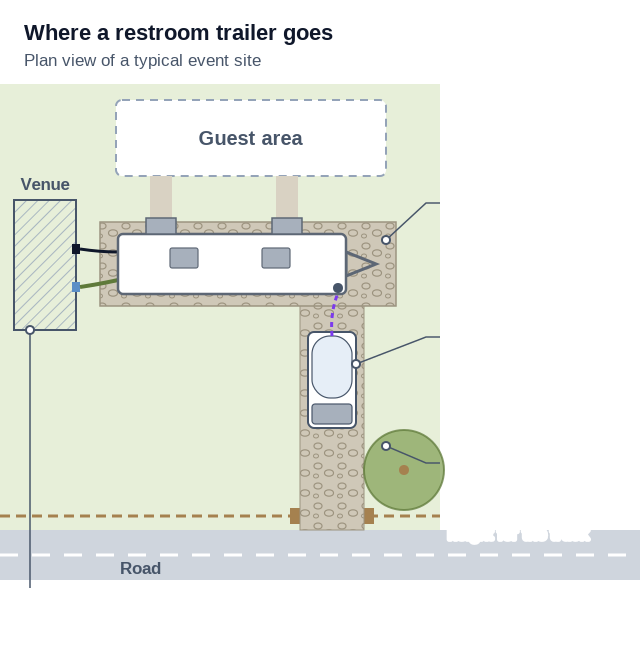
- Placement in parks: the AFRD form says portable restrooms at park events must be on a paved, level surface, never placed on turf, and zip-tied or locked for overnight stays. Parks and Recreation's 2026 policy rules for outdoor events require protective flooring before any driving or infrastructure goes on turf at outdoor festivals, and they bar personal portable toilet tents and similar structures, including camping toilets, restroom privacy tents and pop-up privacy pod tents, from city parks, and say the department may deviate from them at its discretion. If units are not at the location the sub-permit designates, 142-24(b)(1) requires the host to move them immediately, and in no event in more than six hours, after notice from the city.
- Ballfields: under the 2026 Athletic Field Use Policy, portable restroom requests should come at least 14 days ahead with a site plan and company contact information; units must sit on hardscape, be serviced weekly, be removed by the end of the permit and stay locked when not in use, and the organizer is fully responsible for their care.
- Food booths: Code 142-38 requires a food and beverage sub-permit for every outdoor festival serving food or beverages and for other outdoor events where the county regulates that service; for this purpose "beverage" includes water but not alcoholic drinks. The application includes a Fulton or DeKalb County certificate approving the food and beverage service, or, where that county does not require a certificate for the type of food and beverages served, the applicant says so on the application. Georgia rule 511-6-1-.08 requires each temporary booth to have a convenient employee handwashing facility that "shall consist of, at least, a catch bucket, a pressurized or gravity fed supply of warm water, soap, and individual paper towels at the service site," though 511-6-1-.08(2)(i) excludes temporary food services meeting the criteria of Rule 511-6-1-.01(60)(a-f). Fulton's organizer packet (revised 8-9-2018) has the organizer submit all vendor applications at least 30 business days ahead and requires a pre-opening inspection of each vendor booth, with operable hand washing stations in place, before a permit can be issued; the Board's June 2026 events page says applications should generally go in 30 or more days before the event. Confirm with Fulton County Environmental Health, or with the DeKalb County Board of Health for DeKalb sites.
- Pumping and hauling: under Georgia rule 511-3-6-.05(1), only a DPH-certified portable sanitation contractor who is in good standing may remove and dispose of unit waste, and only with a Waste Removal and Disposal Permit. Rule 511-3-6-.03(2) has that permit issued by the county board of health where the hauler's business is based, renewed every year and honored in all Georgia counties. Under 511-3-6-.03(5), an event sponsor or construction site owner using portable units must be able to produce its service contract with a certified company.
Season & Site Notes
- Weather: at Hartsfield-Jackson (NOAA station USW00013874), the 1991-2020 normals put July's average high at 90.1°F and July rainfall at 4.75 inches. January averages a 35.6°F low and 12.8 days with a minimum of 32°F or lower, so ask how a trailer's water lines are protected for overnight placements.
Neighborhoods & Suburbs Served
Downtown · Midtown · Old Fourth Ward · Inman Park · Grant Park · West End · Virginia Highland · Buckhead Village · Decatur · Brookhaven · Sandy Springs · East Point
Emergency Response Expectations
For a short-notice Atlanta booking, check the permit calendar first: the restroom sub-permit application is due no later than 30 days before an outdoor event under section 142-39(c). Give the supplier the location and delivery and removal times on your approved sub-permit; availability depends on the provider.
Atlanta FAQs
Does a small event on Atlanta public property still need the restroom sub-permit?
The code says it does. Under section 142-101, a public-property event expected to draw fewer than 75 people that is not an assembly or overnight event needs no outdoor event permit, but an activity requiring a sub-permit, which 142-24(a) makes portable restrooms, still needs one from MOSE before it takes place.
Which festival class applies to my Atlanta event?
Section 142-59 classes festivals by anticipated attendance over the entire festival: Class A at 50,000 or more, B at 20,000-49,999, C at 10,000-19,999 and D at 2,000-9,999. Class E covers 250-1,999 on public property or 500-1,999 on private property, and a smaller event that otherwise meets the festival definition and offers activities open to the public, such as entertainment or vending, may be considered Class E. A festival is assumed commercial unless the applicant documents non-commercial status by one of the methods 142-59(b) lists.
Do Atlanta restroom trailers fall under the 5 percent accessible-unit exception?
Not as written. Exception 3 to section 213.2 of the 2010 ADA Standards applies where multiple single user portable toilet or bathing units are clustered at a single location; for those, "no more than 5 percent of the toilet units and bathing units at each cluster shall be required to comply with 603," and compliant units must be marked with the International Symbol of Accessibility. It does not cover multi-user restroom trailers, and the AFRD form separately requires a minimum of 1 ADA unit per portable toilet cluster.
What toilet count applies to construction crews on an Atlanta job site?
Where portable units supplement or serve in lieu of sewered toilets, Georgia rule 511-3-6-.03(7)(b) points to the most current OSHA construction toilet regulations for the minimum count of portable units at anticipated peak attendance, once any sewered seated or urinal toilets on the site are taken into consideration. OSHA's Table D-1 (29 CFR 1926.51(c)(1)) lists one facility for 20 or less employees, and 1 toilet seat and 1 urinal per 40 workers at 20 or more, or per 50 workers at 200 or more. Paragraph (c)(2) adds that under temporary field conditions "provisions shall be made to assure not less than one toilet facility is available," and (c)(4) says the toilet requirements do not apply to mobile crews having transportation readily available to nearby toilet facilities.
Sources
- Atlanta Code of Ordinances, Chapter 142, Outdoor Events
- City of Atlanta MOSE: Outdoor Festival Permit Application
- City of Atlanta MOSE: Outdoor Events Fees
- City of Atlanta MOSE: Sub-Permit Applications
- City of Atlanta: AFRD Restroom Plan (restroom sub-permit form)
- City of Atlanta MOSE: Large Gathering in a Park Permit Application
- Atlanta Parks and Recreation: 2026 Policy Rules for Outdoor Events in City Parks
- City of Atlanta Department of City Planning: NPU by Neighborhood
- Fulton County Board of Health: Information on Temporary Food Events & Street Vending (June 2026)
- Fulton County Board of Health: Special Event Organizer Information Packet (revised 8-9-2018)
- Ga. Comp. R. & Regs. 511-6-1-.08, Special Food Service Operations (Georgia Secretary of State)
- Ga. Comp. R. & Regs. 511-3-6, Portable Sanitation Contractors (Georgia Secretary of State)
- eCFR: 29 CFR 1926.51, Sanitation (Table D-1)
- U.S. Department of Justice: 2010 ADA Standards for Accessible Design
- NOAA NCEI: 1991-2020 monthly normals, Atlanta Hartsfield (USW00013874)
- U.S. Census Bureau: 2020 Census place codes for Georgia, with counties
- Stahla: 2026 restroom trailer pricing guide (Jan. 8, 2026; table updated Oct. 15, 2026) (third-party estimate)
Last reviewed 2026-11-04
Services Available in Atlanta
Restroom Trailer Rental
Multi-stall restroom trailers with running water, climate control, and interior finishes — quoted by local rental providers.
Learn more →Luxury Restroom Trailer Rental
Premium trailers for weddings and upscale events — wood-look interiors, AC/heat, and attendant options from local providers.
Learn more →Wedding Restroom Trailers
Elegant restroom trailers sized for your guest list — barn, vineyard, and estate weddings deserve better than a porta-potty row.
Learn more →Event Restroom Trailers
Restroom trailers for festivals, corporate events, and public gatherings — sized to attendance and quoted by local providers.
Learn more →Construction & Long-Term Rentals
Job-site restroom trailers and porta-potties with scheduled service — OSHA-ratio sizing and monthly rates from local providers.
Learn more →Porta Potty Rental
Standard and ADA portable toilets for job sites and events, with scheduled service — quotes from local sanitation providers.
Learn more →Free Tools Before You Call
Ballpark the cost or narrow down the problem before talking to an Atlanta provider.
Restroom Trailer or Porta Potties? 60-Second Decision Quiz
Trailer or porta potties? Answer a few quick questions about your event and get an honest verdict — plus the exact tool to size and price it.
Use the free tool →Restroom Trailer Size Calculator
Find out how many stalls — and which trailer size — your guest count actually needs, with alcohol and event length factored in.
Use the free tool →Restroom Trailer Rental Cost Estimator
Get a realistic 2026 price range for renting a restroom trailer — by size, rental length, season, and extras.
Use the free tool →Need help in Atlanta, GA?
Send the short form — urgent requests get priority routing.