Restroom Trailer Rental in Miami, FL
Porta potty rental typically runs $150–$300 nationally, per our cost guide. Independent local pros serving Brickell Village, Brickell Key, Edgewater and nearby areas. Describe the problem and we'll route your request — free, no obligation.
- Sizing from real planning math — one stall per 50 guests is the starting point
- Share your venue, load-in, or site schedule up front
- Power, water, and level-ground questions to settle before the quote
- Free to use — providers set their own pricing, you compare in writing
Fast response from independent local providers. No obligation.
Typical national cost$150 – $300Cost guide →Local Help in Miami, FL
In the City of Miami, special events are governed by Chapter 52 of the City Code, which Municode's history note ties to Ordinance No. 14357 (3-13-25). Section 52-2(a) makes it unlawful to conduct or engage in a special event without first obtaining an approved special event permit, and the permit delineates the event's other temporary uses, such as tents, temporary structures, barricades and fencing. Under section 52-2(j), a special event hosted, not sponsored, by the city, such as a street naming ceremony, food drive/giveaway or holiday celebration, needs no special event permit. Section 52-1 treats hosting as the city using its own resources and services as host, and sponsorship as monetary and/or in-kind support where the city is recognized through permissible use of the city seal or other similar recognition.
The code sizes events by how many people are reasonably expected to attend at any given time: small up to 250, medium 251 to 1,000, large more than 1,001. Section 52-3 wants a complete, written and notarized application at least 30 days before a small or medium event and 45 days before a large one, a lead time it says allows arrangements for sanitation (litter, debris and human wastes), wastewater, utilities, building permitting and inspection, among other things. A late application is considered only on payment of double the application fee and if city staff are available to review it.
The city's Office of Film & Entertainment takes special event applications; for a City of Miami park, the city's permit page says to reserve a park facility first, and that office will advise whether a special event permit is also needed. Miami-Dade County requires its own Parks Special Events Permit for an event in county-owned and operated park and recreation facilities.
Miami Service Details
What providers in this area actually see: coverage, common jobs, local pricing factors, and rules worth knowing.
Service Area Notes
- Brickell Village, Brickell Key, Edgewater, Midtown, Design District, East Little Havana, Lemon City/Little Haiti, North Grove and South Grove are names on the City of Miami's GIS neighborhoods layer, which the city describes as a general reference map of well known City of Miami neighborhoods.
- Miami Beach, Coral Gables, Doral, Aventura, Homestead and Hialeah are listed as separate incorporated cities in Miami-Dade County in the Census Bureau's 2020 Florida place-by-county file. Chapter 52 of the City of Miami Code does not govern events in those cities; each applies its own event and park rules.
Common Jobs in Miami
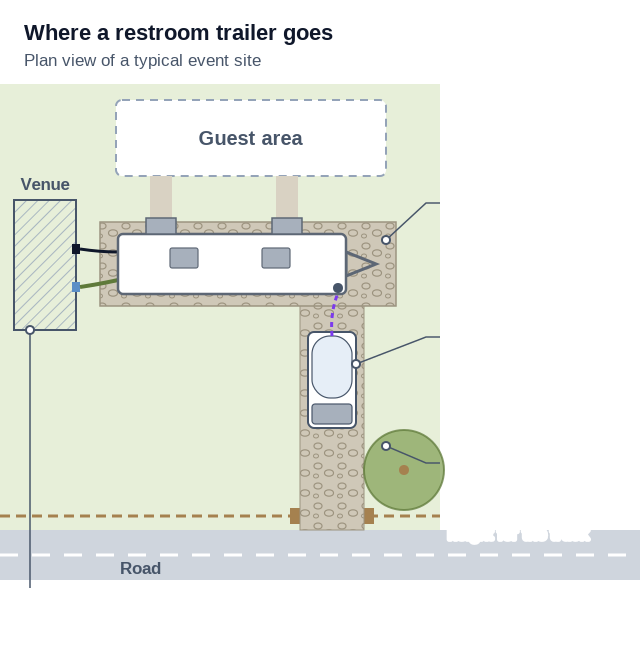
- Restroom and hand wash counts, regular and handicapped, drawn on City of Miami special event site plans
- Portable toilets listed on the city's special event building affidavit in place of a building permit
- Restroom trailers for Miami-Dade Parks events sorted into Class A to D by length and attendance
- Daily-serviced portable restrooms with hand wash units at festivals serving food
- Jobsite toilets counted under OSHA Table D-1 for Miami construction crews
What Drives Pricing Here
- Published list prices from one national vendor, not Miami quotes: Stahla Services' January 8, 2026 guide to restroom trailer rental cost carries a pricing table labeled "Updated 10.15.2026" listing $2,799 per event for a 2 stall restroom trailer, $7,199 for a 3 stall ADA restroom trailer and $5,699 for a 10 stall trailer, an event meaning Friday delivery and Monday pickup. Stahla labels the figures base rates, good for 30 days and exclusive of additional fees, and among the factors it says change actual cost it lists an ADA trailer's setup at $1,999 and pack up at $1,499, against $1,499 and $999 for a standard trailer, and $3.99 per loaded mile for mobilization.
- Servicing and disposal: Florida's portable restroom rule has units at special events serviced at least daily and requires their contents to be removed in their entirety when pumped, so each visit belongs on the quote.
- City charges: section 52-4(a) leaves the application fee to the city manager or designee. The permit page lists amounts under an "As of May 15th, 2025" heading rather than in a schedule stating an effective date, so ask the special events office for current charges. Section 52-4(d) lets the city require a refundable security deposit, to be refunded about three to four weeks after the event if all conditions are followed, public property is left in as good condition or better and without damage and all city invoices are paid; failing to comply with conditions may forfeit all or part of it. Section 52-4(f) adds a per-day charge per linear foot of street the event obstructs, which the Resilience and Public Works director may prorate hourly for events under 24 hours.
Permits & Local Rules
- Site plans: the city's permit page asks for an 11"x17" site plan for an outdoor event, or floor plans for an indoor one, mechanically drawn to 1/4" scale. Among many other items, its instructions call for bathrooms and hand washing stations counted as regular and handicapped, generator sizes and where the electricity is coming from; read the full list on the permit page.
- Building affidavit: under a city pilot program, a Special Events Affidavit filed with the permit application replaces the building permit and its inspections for three items only: tents up to 40x40 feet, portable toilets and generators up to 50 kVA. The Building Department form is headed for events of 14 days or less and applies only to projects holding a special event permit number issued by the Office of Film and Entertainment and to City of Miami hosted events. Signers accept that licensed personnel of their choosing, not the Building Official, review plans and inspect, attest that ADA requirements have been met and agree to remove all installed facilities within 7 days of the event's conclusion. The packet must show the Life Safety plan and the location of all temporary structures, temporary toilets and generators, and signers accept an indemnification clause. The form also says the Building Department reserves the right to perform site inspections, and any change to an approved affidavit packet must be filed with the Office of Film and Entertainment for any corrections or added requirements; read the full form before relying on it.
- Longer installations: Building Department Bulletin 2026-001, effective June 25, 2026, issues Special Events building permits only for events lasting 45 days or less, refers longer applications and improvements left in place more than 45 days to the Department of Environmental Resources Management (DERM), and does not accept work such as new connections to water and sewer lines under a Special Event building permit.
- City parks: City Code section 38-74(a)(11) requires a park permit to erect a tent or other temporary structure, and section 38-75 makes such permits nontransferable, good only on the date specified, and subject to special conditions printed on the permit forms; any required deposit is returned after park personnel verify the facility has been cleaned up.
- Coconut Grove: applicants there also pay a supplementary fee and present the event for approval at the monthly Coconut Grove Business Improvement District meeting, and the city recommends starting at least 60 days ahead.
- Miami-Dade Parks: the county reviews an Event Proposal Overview within five business days and then says which application to complete, noting that approval to move forward does not guarantee a permit. Classes run from A (more than 7 days, under 5,000 attendees) to D (1 day, up to 250), plus Public Demonstration. The page states deadlines inconsistently (for Class C, 45 days in its class table and Step 2 list, 21 days for the completed application and in its FAQ), so confirm dates with Parks. Its FAQ says all food service concessions and restroom facilities must meet HRS (Health and Rehabilitative Services) requirements and lists DERM permits for waste water disposal, among others.
- Food booths: Rule 61C-4.010(8)(a) excuses food vendors at temporary food service events from providing public bathroom facilities. DBPR's temporary event guide lists a hand washing facility among a vendor's basic inspection items, which may be a food-grade container fitted with an on/off valve, its water drawn from an approved source, and says sponsors should notify its Division of Hotels and Restaurants, no less than three business days before the event, of the type of food service proposed, the event's time and location, a complete list of participating food service vendor owners and operators and the current license number of each participating public food service establishment, sending that with the sponsor's contact information; the guide also points sponsors to the notification requirements on DBPR Form HR 5030-034. DOH in Miami-Dade's Food Hygiene page lists other food operations that department regulates, including civic and fraternal organizations, so ask which agency inspects a given booth.
Season & Site Notes
- Weather: NOAA's 1991-2020 monthly normals for MIAMI INTL AP (station USW00012839) give an August normal high of 90.7°F and normal low of 77.7°F, and normal precipitation of 10.51 inches for June against 1.83 inches for January.
- Storm season: the National Hurricane Center gives June 1 through November 30 as the Atlantic hurricane season, and City Code section 52-6(10) lets the city manager or designee deny a permit when a federal, state or local emergency has been declared by lawful authority for the proposed time.
Neighborhoods & Suburbs Served
Brickell Village · Brickell Key · Edgewater · Midtown · Design District · East Little Havana · Lemon City/Little Haiti · North Grove · South Grove · Miami Beach · Coral Gables · Doral · Aventura · Homestead · Hialeah
Emergency Response Expectations
A short-notice Miami event that needs a special event permit is still bound by Chapter 52's filing periods and late-application terms described above. Confirm the permit's status and the units drawn on the approved site plan before treating a delivery date as firm.
Miami FAQs
How many toilets does a City of Miami special event need?
Chapter 52's text sets no toilet ratio, but the site plan must count regular and handicapped bathrooms, and section 52-8(c) lets the city manager or designee attach conditions and safeguards to a permit. Absent a local or state minimum, Rule 62-6.0101(7)(d) has portable restroom service company operators size special events from its Table PR I, which assumes one service per day.
How many accessible units should a Miami event plan for?
Section 52-6(4) lets the city deny a permit for an event not in compliance with the Americans with Disabilities Act. The third exception to section 213.2 of the 2010 ADA Standards covers multiple single user portable toilet or bathing units clustered at a single location: no more than 5 percent of those units at each cluster are required to comply with section 603, and complying units are identified by the International Symbol of Accessibility; it does not address multi-stall restroom trailers. For special events a county department sponsors, Miami-Dade Procedure 582 (effective 01/22) requires an accessible route to the portable toilets, five percent of the toilets to be accessible, at least one accessible unit in each distributed cluster and a contract model the county has certified as ADA compliant. An older City of Miami special-event ADA procedure is posted on the city's archive site but not linked from the city's current ADA page, so ask the ADA Coordinator named on the Risk Management ADA page what applies now.
Which jobsite toilet rules reach Miami construction crews?
OSHA's Table D-1 in 29 CFR 1926.51(c)(1) calls for 1 facility for 20 or fewer employees, 1 toilet seat and 1 urinal per 40 workers for 20 or more, and 1 toilet seat and 1 urinal per 50 workers for 200 or more, and (c)(4) exempts mobile crews having transportation readily available to nearby toilet facilities. Section 203.2 of the 2010 ADA Standards exempts portable toilets provided for use exclusively by construction personnel from section 213 and from the accessible route requirement.
Which companies can service the units and take the waste away?
Rule 62-6.0101 requires an annual DEP permit (Form DEP 4013) for a company servicing portable restrooms, hand washing units or holding tanks, issued for the county where it keeps an office or storage yard; it needs none in a neighboring county without one, though its staff there carry proof of the current permit and vehicle inspection. An owner of units without that permit must hold a contract with a permitted servicer covering each unit in use and display the owner's name and telephone number on every unit in use. Waste is hauled so as to preclude leakage, spillage or a sanitary nuisance and disposed of into a treatment facility approved or permitted for such disposal by the Department, and the rule also sets hauling-log duties. DOH in Miami-Dade takes sanitary nuisance complaints under section 386.041, Florida Statutes.
Does the state need to hear about the restroom contract for a Miami festival?
Yes. Rule 62-6.0101(7)(d) requires event organizers to deliver to the Department, one working day ahead or earlier, a signed copy (a fax is acceptable) of their agreement with the service company listing the on-site dates, the unit count, how often servicing happens and the removal date. The rule also says all required restroom facilities shall remain accessible whenever the intended users are present. Check with DEP's Onsite Sewage Program on where the contract goes.
Sources
- City of Miami: Get a Special Event Permit (Office of Film & Entertainment)
- City of Miami: Filming and Events
- City of Miami Code, Chapter 52, Special Events (Municode)
- City of Miami Code, Chapter 38, Article II, Park Use Regulations (Municode)
- City of Miami Building Department: Special Event Building Permit Affidavit
- City of Miami Building Department: Bulletin 2026-001, Special Events Building Permits (effective June 25, 2026)
- City of Miami Risk Management: ADA
- City of Miami GIS: Neighborhoods map service
- Miami-Dade Parks: Parks Special Events Permit
- Miami-Dade County: ADA Procedure 582, ADA Accessible Special Events (effective 01/22)
- Florida Administrative Code: Rule 62-6.0101, Portable Restrooms and Portable or Stationary Holding Tanks (effective 6/21/2022)
- Florida DEP: Onsite Sewage Program
- Florida Administrative Code: Rule 61C-4.010, Sanitation and Safety Requirements (effective 10/18/2023)
- Florida DBPR: Guide to Temporary Food Service Events
- DOH in Miami-Dade: Food Hygiene
- DOH in Miami-Dade: Sanitary Nuisances
- eCFR: 29 CFR 1926.51, Sanitation (Table D-1)
- ADA.gov: 2010 ADA Standards for Accessible Design
- NOAA NCEI: 1991-2020 monthly normals, MIAMI INTL AP (USW00012839)
- NOAA National Hurricane Center: Tropical cyclone climatology
- U.S. Census Bureau: 2020 Florida place-by-county reference file
- Stahla: Restroom trailer rental cost guide (Jan. 8, 2026; pricing table updated Oct. 15, 2026) (third-party estimate)
Last reviewed 2026-11-05
Services Available in Miami
Restroom Trailer Rental
Multi-stall restroom trailers with running water, climate control, and interior finishes — quoted by local rental providers.
Learn more →Luxury Restroom Trailer Rental
Premium trailers for weddings and upscale events — wood-look interiors, AC/heat, and attendant options from local providers.
Learn more →Wedding Restroom Trailers
Elegant restroom trailers sized for your guest list — barn, vineyard, and estate weddings deserve better than a porta-potty row.
Learn more →Event Restroom Trailers
Restroom trailers for festivals, corporate events, and public gatherings — sized to attendance and quoted by local providers.
Learn more →Construction & Long-Term Rentals
Job-site restroom trailers and porta-potties with scheduled service — OSHA-ratio sizing and monthly rates from local providers.
Learn more →Porta Potty Rental
Standard and ADA portable toilets for job sites and events, with scheduled service — quotes from local sanitation providers.
Learn more →Free Tools Before You Call
Ballpark the cost or narrow down the problem before talking to a Miami provider.
Restroom Trailer or Porta Potties? 60-Second Decision Quiz
Trailer or porta potties? Answer a few quick questions about your event and get an honest verdict — plus the exact tool to size and price it.
Use the free tool →Restroom Trailer Size Calculator
Find out how many stalls — and which trailer size — your guest count actually needs, with alcohol and event length factored in.
Use the free tool →Restroom Trailer Rental Cost Estimator
Get a realistic 2026 price range for renting a restroom trailer — by size, rental length, season, and extras.
Use the free tool →Need help in Miami, FL?
Send the short form — urgent requests get priority routing.