Restroom Trailer Rental in Chicago, IL
Porta potty rental typically runs $150–$300 nationally, per our cost guide. Independent local pros serving Loop, Lincoln Park, Hyde Park and nearby areas. Describe the problem and we'll route your request — free, no obligation.
- Sizing from real planning math — one stall per 50 guests is the starting point
- Share your venue, load-in, or site schedule up front
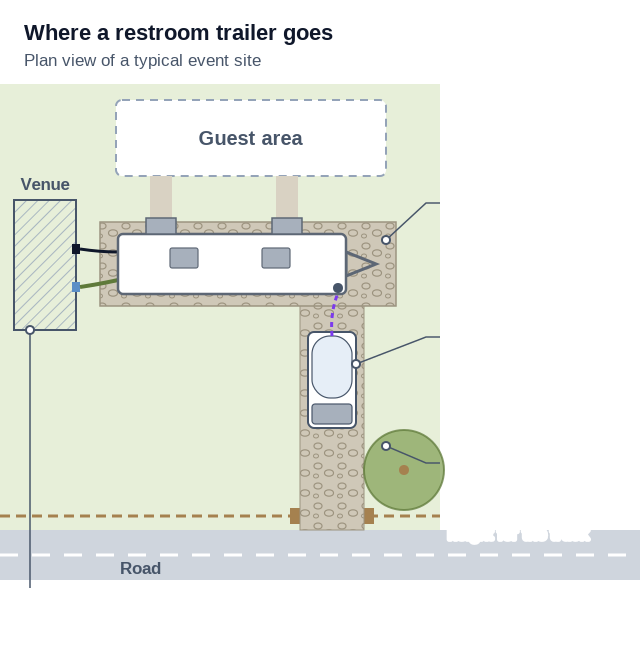
- Power, water, and level-ground questions to settle before the quote
- Free to use — providers set their own pricing, you compare in writing
Fast response from independent local providers. No obligation.
Typical national cost$150 – $300Cost guide →Local Help in Chicago, IL
Several Chicago offices can have a say in where rented restroom trailers and portable toilets go and how many an event needs. The Department of Cultural Affairs and Special Events (DCASE) permits outdoor special events under section 10-8-335 of the Municipal Code of Chicago, the Chicago Park District issues its own permit for events on park property, and the Department of Buildings (DOB) states toilet and handwashing minimums for temporary events in its small temporary structure permit terms. Statewide, an Illinois Department of Public Health (IDPH) rule requires a portable sanitation business license of anyone operating in Illinois who sells, rents, leases, transports, services, cleans, sanitizes or maintains portable toilets or portable potable hand washing units, or pumps, transports or disposes of their waste.
Section 10-8-335 covers planned temporary aggregations of attractions held on the public way, and those held primarily outdoors on other property open to the public when they include activities that require a City temporary food establishment license or special event liquor license, or need special City services such as street closures, barricades or special police protection. It excludes parades and athletic events that need permits under sections 10-8-330 or 10-8-332, licensed farmers markets and independent farmers markets that need a market registration, neighborhood block parties at which no food, beverages or merchandise is sold, and citywide festivals held under an intergovernmental agreement authorized by ordinance. The sponsor of a covered event must obtain a DCASE permit.
DOB's terms say permanent toilet facilities or temporary nonsewer toilet facilities for temporary events must meet the Chicago Plumbing Code's minimum quantities: at least 2 toilets when more than 30 people are present, and above 600 people, at least 1 toilet for every additional 300 (or fraction of 300) people present. In most cases, the terms add, a share of them must be accessible to people with disabilities: at least 5 percent, and no less than one.
Chicago Service Details
What providers in this area actually see: coverage, common jobs, local pricing factors, and rules worth knowing.
Service Area Notes
- On park property, a Park District Special Event Permit is required for outdoor activities with any listed feature, such as 50 or more people, alcohol, amplified sound, generators, stages, tents or vendors; athletic games, practices and tournaments of any size, and gatherings of 49 people or less, without the listed features are arranged with the park directly. The District provides no portable toilets; it says restrooms in public spaces may be available to attendees but are not guaranteed, and that fieldhouses are not required to be open for events.
- Evanston and Oak Park (Evanston city and Oak Park village, both Cook County places in the Census Bureau's 2020 Illinois list of places by county) are separate municipalities with their own event, park and health rules; a DCASE or Chicago Park District permit does not cover them.
Common Jobs in Chicago
- Street festivals and art or craft fairs permitted by DCASE
- Park District events with units on a hard surface at an approved site-map location
- Accessible units placed in every group of single-user toilets
- Self-contained hand washing units for food booths
- Construction crews' units matched to OSHA Table D-1 headcounts
What Drives Pricing Here
- Vendor list prices: Stahla Services' guide, dated January 8, 2026, with a rate table it marks updated 10.15.2026, prices its 2-stall restroom trailer for $2,799 per event and its 8-stall unit for $4,799 per event or $6,899 per week; an event booking spans Friday delivery through Monday pickup. These are one vendor's published rates, not a Chicago average.
- Add-ons: the guide calls those base rates valid for 30 days, excluding additional fees, and says actual costs vary with mobilization (charged per loaded mile), trailer setup and pack-up (setup $1,999 and pack-up $1,499 for an ADA trailer, $1,499 and $999 for others), location, duration, seasonal demand and amenities; its table also lists a Heat Lock line at $499 per event.
- Grouping: each group of single-user portable toilets at a park event needs its own wheelchair-accessible unit under the District's guidelines, so splitting units into several banks raises the accessible count.
Permits & Local Rules
- DCASE fee and deadline: section 10-8-335(c) attaches a nonrefundable processing fee that rises the closer to the event the application is submitted (waived for an independent farmers market, though not other fees) and bars accepting any application fewer than 21 days ahead of the event. DCASE's page says that, effective September 29, 2025, it bases the fee on the date an application has all accurate and required documents submitted; because the code's history gives council journal dates rather than an effective date for the current amounts, get the fee from DCASE.
- Sponsor duties under the code: submit applications for necessary licenses, including food and alcoholic beverage licenses, to DCASE at least 20 days before the event; keep the public way clean during the event; and when the permit ends, remove all materials and equipment, clean the street and restore any damaged public way.
- DOB nonsewer toilets (terms effective November 6, 2023): units must meet Chicago Plumbing Code specifications, be kept sanitary and regularly serviced, and on private property be placed 5 feet or more from property lines. Where a temporary nonsewer toilet serves workers or the public, temporary handwashing must also be provided per the Plumbing Code.
- Park District accessibility: where multiple single-user portable toilet or bathing units are grouped at one location, at least 5 percent, but not less than one unit at each group, shall be wheelchair accessible; the Mayor's Office for People with Disabilities encourages 10 percent, not less than one per group. Accessible routes to the toilets must be maintained, on a level area not exceeding a 2 percent cross-slope in any direction. A lone portable toilet must be accessible at a public event but may be non-accessible at a private, non-public one.
- DCASE's accessibility guidance calls for accessible portable restrooms, kiosks and drinking fountains to be available on site in event areas, and says a combination of foot-lever and push-button handwashing machines is generally preferred.
- Food booths: CDPH's outdoor special event food guidelines, printed in DCASE's 2026 Special Events Resource Guide, require hand washing facilities in each facility, at minimum a self-contained unit providing water under pressure, with separate fresh water and wastewater holding tanks, soap, paper towels and a waste receptacle. Common towels are prohibited. Each vendor needs at least one 55-gallon drum, open at one end and covered with tightly fitted 1/4-inch mesh screening, to receive food preparation wastewater, and additional drums may be necessary for large operations; every wastewater drum, including beer icing barrels, is pumped out nightly by a contractor with vacuum truck equipment and delivered to the Metropolitan Water Reclamation District, not emptied into public sewers at the site. The Health Officer may waive or modify requirements when, in the officer's opinion, a health hazard is not likely to result.
- Servicing: under 77 Ill. Adm. Code 905.135 (effective August 28, 2013), only IDPH-certified portable sanitation technicians or trainees working for a licensed business may service, clean, sanitize or maintain units or pump, transport or dispose of their waste. Units are cleaned and sanitized after each pumping or as part of routine service. Anti-bacterial hand sanitizer is provided at each unit and refilled at each pumping as needed; instead of refilling it at each unit, one portable potable hand washing unit with single-use towels and soap may be provided for up to 5 portable toilets, located within 20 feet of them, and the dispensers and hand washing facilities must be cleaned and sanitized after each pumping, then refilled with potable water from an approved source. The licensing act (225 ILCS 225/4(c)) exempts people who clean, pump, haul or dispose of waste from chemical toilets in an underground coal mine; that waste must be either transported to and disposed of at an Illinois EPA-permitted sewage treatment facility on the mine property, or stored on-site in a sanitary manner pending removal and disposal by a licensed private sewage disposal pumping contractor.
- Waste disposal: section 905.170(g) allows portable toilet waste to go to a municipal sanitary sewer with the municipality's written approval, or to a sludge lagoon or drying bed, incinerator or sanitary landfill approved by the Illinois EPA or whose operator holds an Illinois EPA permit to receive the septage (a contractor building its own lagoon or drying bed needs an Illinois EPA permit to construct and operate it); 905.170(h) bars applying it to agricultural land.
Season & Site Notes
- Winter: NWS Chicago's 1991–2020 normals for O'Hare put January's normal high at 31.6°F and normal low at 18.8°F, with 16.5 January days on average with highs at or below 32°F. Ask the supplier what temperatures a trailer's water system is rated for.
- The same normals list 38.4 inches of annual snowfall and a July normal high of 84.5°F. The Park District clears only a predetermined snow and ice route and cannot clear undesignated driveways, paths or areas for a privately organized event, so plan who keeps the accessible route to the units clear.
Neighborhoods & Suburbs Served
Loop · Lincoln Park · Hyde Park · West Town · Lake View · Near South Side · Evanston · Oak Park
Emergency Response Expectations
For a short-notice Chicago order, DCASE will not accept a special event application fewer than 21 days ahead, the Park District must approve each unit's location before delivery, and the company servicing the units must hold an IDPH portable sanitation business license.
Chicago FAQs
Does an outdoor event in Chicago need a DCASE special event permit?
DCASE says all outdoor events in the City must apply if any of these apply: they will close City streets (not allowed for private events), sell or serve food on public or private property open to the public, sell or serve alcohol, sell merchandise, have tents larger than 20 ft. by 20 ft. (400 sq. ft.), or have stages taller than 2 ft.; bar crawls have their own thresholds. It lists outdoor weddings and receptions, invitation-only private events not open to the public, block parties (contact your alderman) and parades, processions, rallies and marches (contact CDOT) as not needing one. The Park District's version of the list words the food item as preparing food, so confirm with DCASE.
What does the Chicago Park District require before toilets are delivered?
Its 2026 permit application and its resource guide say every portable toilet must be placed on a hard surface (the District names asphalt, concrete or plywood), be clearly identified on the site map, and have its location approved prior to delivery; beach units go on pavement in a pre-approved location. Units must be installed and removed during the permit times or at a time the District specifies. The guide's checklist asks for the site map, the portable toilet contract or invoice and the permit holder's general liability insurance.
Who is responsible when portable toilets are not serviced often enough?
IDPH's rule requires service at a frequency that keeps units sanitary and free of odors, and says the employer, property owner or event coordinator shall acquire more units or adjust the service and maintenance to ensure sanitary conditions. A property owner's failure to provide enough units, or service frequent enough to keep them sanitary, is a violation, and the licensed business is accountable for the cleaning, pumping and disposal done by its certified staff.
What toilet rules apply on a Chicago construction site?
OSHA's Illinois State Plan page says federal OSHA standards apply to private-sector employers in Illinois. Under 29 CFR 1926.51(c)'s Table D-1, a site with 20 or less employees needs 1 toilet; with 20 or more, 1 toilet seat and 1 urinal per 40 workers; with 200 or more, 1 toilet seat and 1 urinal per 50 workers. Mobile crews having transportation readily available to nearby toilet facilities are exempt from those sanitation requirements. For a temporary building or a building under construction not yet occupied for its intended purpose, 410 ILCS 37/10 makes the owner or owner's representative ensure employees have enclosed toilets discharging to a sanitary sewer or portable, enclosed, chemically-treated tank-tight units (separate male and female facilities are not required with individual portable units) in OSHA's numbers, hand cleansing units, regular pumping and cleansing of non-sewered units, and restrooms within 300 feet of the entrance for non-residential buildings or readily available nearby for residential ones. Public Act 104-850 amends that section effective January 1, 2027; read the new text on ilga.gov.
How do accessibility standards treat clustered portable toilets?
The 2010 ADA Standards' section 213.2, exception 3, says that where multiple single user portable toilet or bathing units are clustered at a single location, no more than 5 percent of the units at each cluster shall be required to comply with section 603, and compliant units are identified by the International Symbol of Accessibility. Under section 203.2, portable toilets provided for use exclusively by construction personnel on a construction site need not comply with 213 or be on an accessible route. The Capital Development Board says the Illinois Accessibility Code includes design requirements for public facilities and multi-story housing units as defined in the Code. Park events also follow the District's guidelines above.
Sources
- DCASE (City of Chicago): Special Events Permit Application
- Municipal Code of Chicago §10-8-335, Outdoor special events
- DCASE: 2026 Special Events Resource Guide (CDPH food guidelines)
- DCASE: Accessibility at Outdoor Events
- Chicago DOB: terms for small temporary structures
- Chicago DOB: terms for new construction and temporary structures
- Chicago Park District: Special Event Permit Application, 2026 edition
- Chicago Park District: Special Event Permit Resource Guide
- Chicago Park District: Permits & Rentals 101
- Illinois Administrative Code §905.135 (77 Ill. Adm. Code), Portable Sanitation
- Illinois Administrative Code §905.170 (77 Ill. Adm. Code), pumping and waste disposal
- Illinois General Assembly: 225 ILCS 225, Private Sewage Disposal Licensing Act
- ILGA: 410 ILCS 37/10, Construction Site Temporary Restroom Facility Act
- OSHA: Illinois State Plan
- eCFR: 29 CFR 1926.51
- U.S. Department of Justice: 2010 ADA Standards
- Illinois Capital Development Board: Illinois Accessibility Code
- NWS Chicago: O'Hare 1991–2020 climate normals
- City of Chicago Data Portal: Community Areas
- U.S. Census Bureau: 2020 place-by-county file, Illinois
- Stahla: Restroom Trailer Rental Cost guide (Jan. 8, 2026; table updated Oct. 15, 2026) (third-party estimate)
Last reviewed 2026-11-04
Specialty Services in Chicago
Services Available in Chicago
Restroom Trailer Rental
Multi-stall restroom trailers with running water, climate control, and interior finishes — quoted by local rental providers.
Learn more →Luxury Restroom Trailer Rental
Premium trailers for weddings and upscale events — wood-look interiors, AC/heat, and attendant options from local providers.
Learn more →Wedding Restroom Trailers
Elegant restroom trailers sized for your guest list — barn, vineyard, and estate weddings deserve better than a porta-potty row.
Learn more →Event Restroom Trailers
Restroom trailers for festivals, corporate events, and public gatherings — sized to attendance and quoted by local providers.
Learn more →Construction & Long-Term Rentals
Job-site restroom trailers and porta-potties with scheduled service — OSHA-ratio sizing and monthly rates from local providers.
Learn more →Porta Potty Rental
Standard and ADA portable toilets for job sites and events, with scheduled service — quotes from local sanitation providers.
Learn more →Free Tools Before You Call
Ballpark the cost or narrow down the problem before talking to a Chicago provider.
Restroom Trailer or Porta Potties? 60-Second Decision Quiz
Trailer or porta potties? Answer a few quick questions about your event and get an honest verdict — plus the exact tool to size and price it.
Use the free tool →Restroom Trailer Size Calculator
Find out how many stalls — and which trailer size — your guest count actually needs, with alcohol and event length factored in.
Use the free tool →Restroom Trailer Rental Cost Estimator
Get a realistic 2026 price range for renting a restroom trailer — by size, rental length, season, and extras.
Use the free tool →Need help in Chicago, IL?
Send the short form — urgent requests get priority routing.