Restroom Trailer Rental in Charlotte, NC
Porta potty rental typically runs $150–$300 nationally, per our cost guide. Independent local pros serving Charlotte, Huntersville, Matthews and nearby areas. Describe the problem and we'll route your request — free, no obligation.
- Sizing from real planning math — one stall per 50 guests is the starting point
- Share your venue, load-in, or site schedule up front
- Power, water, and level-ground questions to settle before the quote
- Free to use — providers set their own pricing, you compare in writing
Fast response from independent local providers. No obligation.
Typical national cost$150 – $300Cost guide →Local Help in Charlotte, NC
Charlotte's Solid Waste and Restrooms page for event permits says event organizers are required to provide an adequate number of temporary toilets for event patrons. A percentage of those facilities must be American Disability Act (ADA) compliant and located in an unobstructed area, and every temporary restroom facility must be clearly labeled on the event site plan. The page shows no revision date.
To size that number, the page publishes a Restroom Planning Matrix of the approximate number of units needed by average crowd size and average number of hours at the event: 8 units for a crowd of 1,000 over 4 hours, for example, and 50 for 10,000 over the same 4 hours. If alcoholic beverages are sold or available, the page says to add 40% from the base number required.
City Code section 19-311 counts as a public assembly a festival or demonstration reasonably anticipated to obstruct the normal flow of traffic upon any public street that is collected together in one place, and a festival on the Old City Hall lawn, the Charlotte-Mecklenburg Government Center Plaza, Polk Park, Independence Square Plaza, Arequipa Park or any other city-controlled park. Section 19-312(a) allows no public assembly or parade unless a permit has been obtained and remains unrevoked. The Charlotte Department of Transportation (CDOT) says its event permits cover the city right-of-way (streets and sidewalks) and that it does not issue permits for events on private property.
Charlotte Service Details
What providers in this area actually see: coverage, common jobs, local pricing factors, and rules worth knowing.
Service Area Notes
- This page covers events and job sites in the City of Charlotte, which the Census Bureau's 2020 North Carolina place file lists as Charlotte city, Mecklenburg County.
- Cornelius, Huntersville, Matthews and Pineville appear in that file as incorporated towns in Mecklenburg County, and Mint Hill as a town in Mecklenburg and Union counties. Charlotte's municipal event rules do not govern those towns; each town's own rules apply to events held there.
- On private property, Charlotte's outdoor events planning guide says the event should have the owner's explicit permission, and the organizer will need to be prepared to show proof of it to secure any City resources.
Common Jobs in Charlotte
- Toilet counts for public assembly permits on city streets and plazas
- Restrooms at marshalling and disband areas for parades, road races and charitable walks
- Accessible units with an accessible route at each porta potty location
- Multi-day festival units kept maintained and restocked
- Handwashing and wastewater set-ups beside county-permitted food booths
- Crew toilets on construction sites under North Carolina's adoption of 29 CFR Part 1926
What Drives Pricing Here
- One national vendor's list: in its 2026 guide (dated January 8, 2026, with a pricing table marked Updated 10.15.2026), Stahla Services' figures for one event (Friday delivery to Monday pickup) are $2,799 for its 2 stall restroom trailer and $3,399 for its 4 stall, which also rents for $5,199 a week. Stahla describes them as base rates good for 30 days, before additional fees; they are not Charlotte market prices.
- The same Stahla table puts its 3 Stall ADA Restroom Trailer at $7,199 for one event and lists its Mobile Water and Waste Box at $899 for an event. Charges the note keeps outside the base rates include pack up (listed at $999, and $1,499 for ADA units) and mobilization at $3.99 per loaded mile.
- Water and power: under most rental agreements, Stahla says, the renter is expected to provide on-site water and electrical hookups. Charlotte organizers must supply potable water for event drinking and cooking; Center City events may get it from City-operated fire hydrants through Charlotte Water Customer Service, with fees for each hydrant tap.
- The count in the city's matrix depends on crowd size and hours, before the 40% alcohol add-on. Parades, road races and charitable walks must have restrooms at both the marshalling and disband area, and along the course if necessary.
- Service and pickup: for multi-day events all portable restrooms must be maintained and restocked as needed, and all must be removed at the end of permitted time; the city warns that missing that deadline may result in significant penalties.
Permits & Local Rules
- Filing: section 19-312(b) calls for a written public assembly or parade application at least 30 days before the event, though the permit official shall consider a later one where the event is a spontaneous response to a current event or other good and compelling causes are shown. The section lists everything the application must contain, including a nonrefundable application fee set under section 2-4 of the code; confirm the current amount with CDOT.
- Decision: under 19-312(e) the permit official shall approve or deny an application within 20 days of receipt, and may attach reasonable conditions to any approval under 19-312(c). The city's event permits FAQ says applications may be submitted up to 364 days ahead and the permit is issued only after all City requirements have been met.
- Restroom plan contents: the site plan must indicate the location(s) and number of all restroom facilities. The temporary restroom vendor is responsible for collecting and properly removing grey water from hand-washing, and any need to discharge waste or wastewater into the permanent City sewer or wastewater infrastructure must be coordinated through the Charlotte-Mecklenburg Utilities Department, where the page says associated permits and fees will apply.
- Food booths: Mecklenburg County's Temporary Event Organizer Application (revised 10/25) must reach the county health department with the site map, every Food Vendor Application and payment as one complete packet no later than 15 days before the event, and it asks the organizer to check whether it supplies toilet facilities and waste water disposal for the booths. The department's food page requires a meeting when an event has more than 8 food vendors, while the form says 8 or more; confirm which applies, and the current fees, with the department.
- TFE deadlines: the city's food and alcohol page says no temporary food establishment (TFE) applications will be accepted after the 15-day deadline. The state rule, 15A NCAC 18A .2665(d), sets the same 15 calendar days but does not prohibit applications for substitute vendors submitted no fewer than 3 business days before the event; ask the county how it handles substitutes.
- State booth rules: 15A NCAC 18A .2669(e) requires a handwashing facility used only for employee handwashing, consisting of at least a two gallon container with an unassisted free flowing faucet such as a stopcock or turn spout, soap, single-use towels and a wastewater receptacle, with warm water used for handwashing. Under .2669(h) employees must have access to toilet facilities that are kept clean and in good repair. The county's vendor checklist (Rev. 10/14/24) lists disposal of booth waste water in an approved sewage system or port-a-johns.
- Waste hauling: G.S. 130A-290(a)(32) names material removed from a portable toilet in its definition of domestic septage, and 130A-291.1(c) says no septage management firm shall commence or continue operation without a Department permit; a new firm whose complete application the Department does not act on within 60 business days is deemed permitted and may begin operation if all other applicable requirements are met. Under 130A-291.1(d), septage may be treated and disposed only at a wastewater system the Department has approved under the Commission's rules or at a site the Department permits under that section. NC DEQ's septage page links public records for permitted firms by permit number.
Season & Site Notes
- NOAA's 1991-2020 monthly normals for Charlotte Douglas Airport (station USW00013881) give July a normal high of 90.3°F and August 4.35 inches of normal precipitation.
- In the same normals, January's normal low is 31.8°F, with an average of 16.6 days that month whose minimum is 32°F or lower; December averages 14.4 such days.
Neighborhoods & Suburbs Served
Charlotte · Huntersville · Matthews · Cornelius · Mint Hill · Pineville
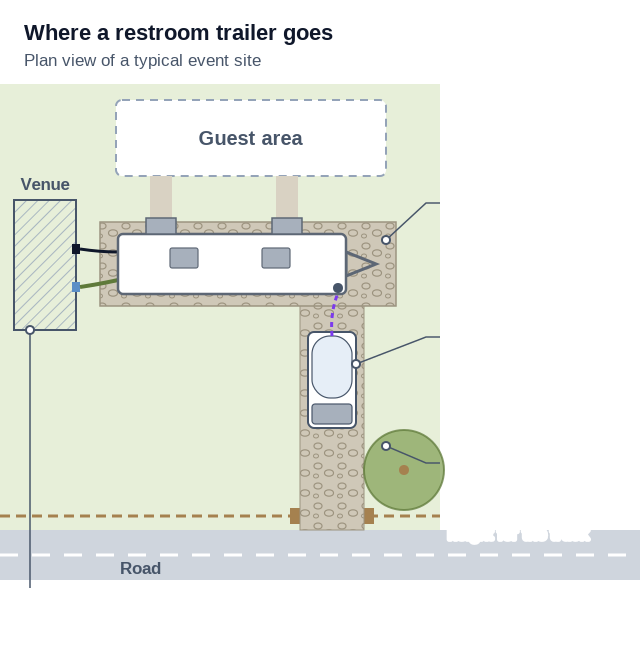
Emergency Response Expectations
A short-notice Charlotte event still faces the filing deadlines: section 19-312(b) asks for a public assembly or parade application at least 30 days ahead, though the permit official shall consider a later one for a spontaneous response to a current event or where other good and compelling causes are shown, and the county wants its food packet no later than 15 days before the event. Whether a trailer or portable units are free on short notice depends on the provider.
Charlotte FAQs
When does Charlotte's 40 percent alcohol add-on apply?
In the city's words, when alcoholic beverages are sold/available: add 40% from the base number required. Selling beer or wine also needs a North Carolina ABC Commission permit, plus a City Beer/Wine Permit if the sale and consumption of alcohol will occur on a public street.
Is Charlotte's accessible-unit rule the same as the federal 5 percent exception?
Not in scope. The city's page states that the ADA requires, at a minimum, 5% and no less than one accessible unit in each porta potty location, with an accessible route to each. The federal text is narrower: Exception 3 to section 213.2 of the 2010 ADA Standards reaches only places where multiple single user portable toilet or bathing units are clustered at a single location, and there no more than 5 percent of the toilet units and bathing units at each cluster shall be required to comply with 603, and units that comply are to be identified by the International Symbol of Accessibility. Multi-user restroom trailers fall outside that exception as written. Confirm the accessible count with the city's permit official.
Can handwashing water or melted ice go into a Charlotte storm drain?
No. Organizers are responsible for collecting and properly disposing of grey water, and the city strictly prohibits pouring grey water, including ice, down City storm water drains, in tree wells, flower beds or any landscaped area. At food booths, 15A NCAC 18A .2669(g) also says wastewater containers shall not be emptied into waterways, storm drains, or on the ground.
Does a company renting portable toilets in Charlotte need a state permit?
Yes. Under 15A NCAC 13B .0832(b)(2), no person may rent or lease portable toilets, contract or subcontract to rent or lease them, or manage or dispose of their waste, regardless of who owns the toilets, unless that person is permitted to operate a septage management firm. Paragraph (b)(3) treats placing a chemical or portable toilet for potential use in North Carolina as operating such a firm, which requires a permit.
What does Mecklenburg County Park and Recreation ask about portable toilets in a county park?
Its Special Events & Festivals Request form, which prints no revision date, lists portable sanitary units among the event activations to check. It says requests will be received a minimum of 90 days and a maximum of 12 months before the event and limits events and festivals to a max of 3 days. The city's planning guide tells organizers wishing to hold an event in a Mecklenburg County park to contact the county's Park and Recreation department.
How many toilets does a Charlotte construction crew need?
North Carolina's rule 13 NCAC 07F .0201 incorporates 29 CFR Part 1926 as promulgated as of January 1, 2025, except as modified in Rules .0202 through .0207. Table D-1 in 1926.51(c)(1) scales with headcount: one facility covers 20 or less employees, crews of 20 or more need 1 toilet seat and 1 urinal per 40 workers; from 200 workers up the minimum is 1 toilet seat and 1 urinal per 50 workers. Paragraph (c)(4) leaves out mobile crews having transportation readily available to nearby toilet facilities.
Sources
- City of Charlotte: Solid Waste and Restrooms
- City of Charlotte CDOT: Event permits
- City of Charlotte: Event permits FAQ
- City of Charlotte: Planning Outdoor Events
- City of Charlotte: Food and Alcohol Sales
- Charlotte Code, Chapter 19, Article XI
- Mecklenburg County Environmental Health: Food
- Mecklenburg County: TFE Event Organizer Application (10/25)
- Mecklenburg County: TFE vendor checklist (10/14/24)
- Mecklenburg County Park and Recreation: Special Events
- Mecklenburg Park and Recreation: Special Events & Festivals Request
- 15A NCAC 18A .2665 (NC OAH)
- 15A NCAC 18A .2669 (NC OAH)
- 15A NCAC 13B .0832 (NC OAH)
- N.C. Gen. Stat. 130A-291.1
- N.C. Gen. Stat. 130A-290
- NC DEQ: Septage
- 13 NCAC 07F .0201 (NC OAH)
- eCFR: 29 CFR 1926.51
- DOJ: 2010 ADA Standards
- NOAA NCEI: 1991-2020 normals, USW00013881
- Census Bureau: 2020 North Carolina place codes
- Stahla: 2026 pricing guide (Jan. 8, 2026; table updated Oct. 15, 2026) (third-party estimate)
Last reviewed 2026-11-05
Services Available in Charlotte
Restroom Trailer Rental
Multi-stall restroom trailers with running water, climate control, and interior finishes — quoted by local rental providers.
Learn more →Luxury Restroom Trailer Rental
Premium trailers for weddings and upscale events — wood-look interiors, AC/heat, and attendant options from local providers.
Learn more →Wedding Restroom Trailers
Elegant restroom trailers sized for your guest list — barn, vineyard, and estate weddings deserve better than a porta-potty row.
Learn more →Event Restroom Trailers
Restroom trailers for festivals, corporate events, and public gatherings — sized to attendance and quoted by local providers.
Learn more →Construction & Long-Term Rentals
Job-site restroom trailers and porta-potties with scheduled service — OSHA-ratio sizing and monthly rates from local providers.
Learn more →Porta Potty Rental
Standard and ADA portable toilets for job sites and events, with scheduled service — quotes from local sanitation providers.
Learn more →Free Tools Before You Call
Ballpark the cost or narrow down the problem before talking to a Charlotte provider.
Restroom Trailer or Porta Potties? 60-Second Decision Quiz
Trailer or porta potties? Answer a few quick questions about your event and get an honest verdict — plus the exact tool to size and price it.
Use the free tool →Restroom Trailer Size Calculator
Find out how many stalls — and which trailer size — your guest count actually needs, with alcohol and event length factored in.
Use the free tool →Restroom Trailer Rental Cost Estimator
Get a realistic 2026 price range for renting a restroom trailer — by size, rental length, season, and extras.
Use the free tool →Need help in Charlotte, NC?
Send the short form — urgent requests get priority routing.