Construction & Long-Term Rentals
Job-site restroom trailers and porta-potties with scheduled service — OSHA-ratio sizing and monthly rates from local providers.
- Sizing from real planning math — one stall per 50 guests is the starting point
- Share your venue, load-in, or site schedule up front
- Power, water, and level-ground questions to settle before the quote
- Free to use — providers set their own pricing, you compare in writing
Fast response from independent local providers. No obligation.
Typical national cost$950 – $7,500Cost guide →About Construction & Long-Term Rentals
Job-site sanitation is a compliance line item with real teeth: OSHA requires toilet facilities scaled to crew size (29 CFR 1926.51 sets the ratios), and superintendents who under-provision hear about it from crews and inspectors alike. OSHA's Table D-1 sets the legal minimum: 1 toilet for 20 or fewer workers, then 1 seat and 1 urinal per 40. The practical standard many providers quote is higher: one unit per 10 workers on a 40-hour week, with weekly servicing included.
We connect contractors, builders, and facility managers with independent local sanitation providers for monthly-rate rentals: standard units for the trades, restroom trailers for office-trailer compounds and client-facing sites, and hand-wash stations to round out the setup. Long-term rentals live or die on service reliability — ask every provider about their route day, missed-service policy, and cold-weather plan.
Common Jobs We Route
- New construction sites from groundbreaking through punch list
- Renovation projects where building restrooms are offline
- Restroom trailers for superintendent compounds and client-walk sites
- Multi-unit and commercial builds needing units repositioned as phases progress
- Roadwork, utility, and infrastructure crews across long corridors
- Facility shutdowns, turnarounds, and temporary workforce surges
What Affects the Price
Providers quote their own work — these are the factors that consistently move the number.
- Unit count from crew size — OSHA's Table D-1 minimum, or the ~1-per-10-workers industry baseline many providers plan to
- Service frequency: weekly is standard; large or high-use sites need twice-weekly
- Rental duration — monthly rates drop meaningfully versus event pricing
- Delivery distance and site access; high-rise and secured sites add handling
- Winter service in freeze markets (antifreeze charge, heated units) and summer demand peaks
- Add-ons: hand-wash stations, holding tanks, ADA units, and trailer-grade facilities
How It Works
- Step 1
Scope the site
Crew size, project duration, site address, and any GC or owner requirements (ADA, hand-wash, trailers).
- Step 2
Get monthly-rate quotes
Local providers quote unit mix, service schedule, and terms. Compare service reliability, not just rate.
- Step 3
Placement and delivery
Units placed for crew access and service-truck reach — repositioned as the site evolves.
- Step 4
Scheduled service
Weekly pump-out, restock, and inspection on a route day, scaling up or down as headcount changes.
In an emergency?
Construction & Long-Term Rentals FAQs
How many units does OSHA require on my site?
OSHA's construction standard (29 CFR 1926.51, Table D-1) sets the legal minimum: 1 toilet for 20 or fewer workers; for 20 or more, 1 seat and 1 urinal per 40 workers; for 200 or more, 1 seat and 1 urinal per 50. That's a floor, not a service plan — the industry rule many providers plan to is one unit per 10 workers per 40-hour week with weekly servicing. Bigger crews, longer hours, or spread-out sites need more. Verify current requirements against the standard and any project-specific specs.
What does a construction porta-potty cost per month?
ZTERS puts a standard construction unit at $125–$275 per month with weekly service and says urban areas may be above $300 (Apr 23, 2026). Stahla's 2026 guide lists $75–$150 a month for long-term rentals, and PolyJohn's ballpark is $75–$100 per month. ZTERS says flushable models, sink add-ons and restroom trailers cost more, and that longer rentals lower the daily rate in most cases. Get it quoted per your site.
Can I get a restroom trailer instead of porta-potties for a long-term site?
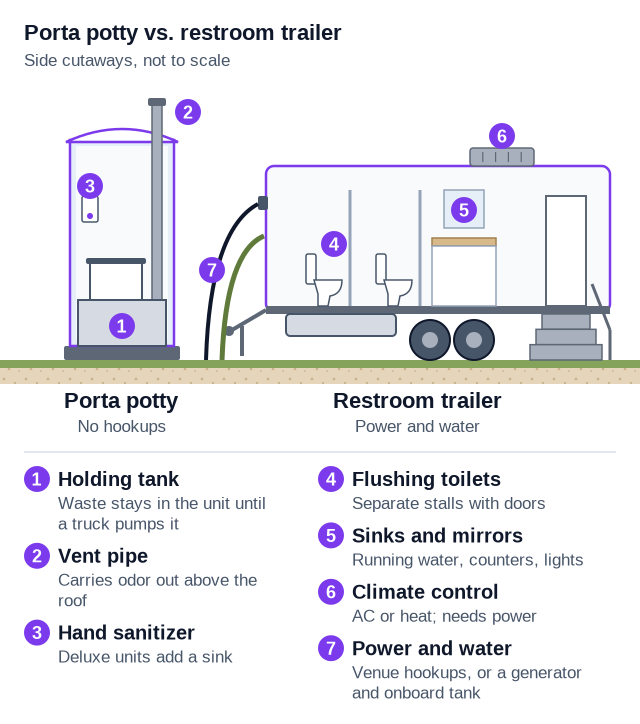
Yes — office compounds, sales centers, and client-facing sites rent trailers monthly, typically with water/power hookups or scheduled tank service. It costs more than standard units but changes the experience for staff and visitors. Providers quote long-term trailer rates separately from event rates.
Construction & Long-Term Rentals by Area
Need construction & long-term rentals?
Send the short form — no obligation.